Fast first aid training is intense deliberately. You are attempting to learn abilities that other people cover in a complete day, usually in a limited half-day or express first aid course. The pace fasts, there is extremely little fluff, and you are tested almost as quickly as you learn something.
The excellent information: lots of people can pass a fast first aid course or express CPR training on the initial effort, also if they have actually not researched in years. The difference between those that pass easily and those who scuff with is generally prep work and mindset, not raw talent.
I have actually shown first aid and CPR courses for greater than a decade, including fast first aid, fast CPR correspondence course sessions, express childcare first aid training, and combined first aid and CPR training classes. The patterns are really clear. If you recognize what the fitness instructors are in fact trying to find, and you arrive all set to find out, your possibilities of entrusting to a first aid certificate on the same day go up dramatically.
This overview will certainly stroll you via what issues, what does not, and how to pile the chances in your favor for a very first time pass.
What "fast" or "express" first aid actually means
Different suppliers use different labels: fast first aid course, express first aid course, fast CPR courses, fast cpr, express cpr course. The framework differs, however the core idea is similar. You complete the exact same across the country acknowledged or recognized first aid and CPR web content, simply in a pressed format.
The speed adjustments. The discovering objectives do not.
In a basic first aid and CPR course, an instructor might spend a long period of time informing stories, gradually building situations, and examining understanding after each little block of material. In a fast first aid training style, you get a focused explanation, you see the skill carried out as soon as, you exercise it briefly, then you move on.
From a learner's point of view, this has consequences.
First, you can not count on rep. You might only see CPR showed two times prior to you are expected to carry out efficient compressions in your assessment.
Second, you need to take obligation for your very own gaps. If you drift off for five mins during a typical first aid course, the trainer may return to the subject again later on. In an express first aid course, that same 5 minute lapse can imply you miss the whole explanation of recuperation position.
Third, there is generally some kind of pre-course study. Lots of fast first aid courses shift concept content right into pre-reading or online modules to keep face-to-face time concentrated on hands-on abilities. If you ignore that work, the class session will certainly feel like a foreign language.
Passing a fast first aid course on the first try is much easier when you comprehend that trade: less class time, more obligation on you.
Choosing the ideal fast first aid course for your goal
Not all first aid training is interchangeable. Prior to you reserve the local fast first aid course near me search result, obtain clear on what you really need.
Workplace demands, professional registration bodies, and child care policies frequently define not simply "first aid", yet a certain type of first aid and CPR course, and even a details system code. An express child care first aid course, as an example, normally covers bronchial asthma and anaphylaxis procedures in a lot more depth than a standard CPR course.
If your goal is purely individual - being able to aid family or friends - then a basic first aid and CPR training course is generally enough. If you are a teacher, very early youth employee, physical fitness instructor, aged treatment employee, security officer, or comparable, you might be called for to hold a specific fast certification that matches your role.
When looking at carriers, inspect three points in particular:
Is the course nationally recognised or approved by your industry regulator or company? Does the fast first aid course or express cpr course consist of both concept and hands-on assessment on the day? Does the provider clearly describe pre-course needs, such as on the internet knowing components or analysis?If those three are strong, great information like place and car park matter more than brand. A fast first aid course near me that you can really get to unwinded and promptly deserves greater than a prestigious carrier that needs a 2 hour commute.
The night-before list that really helps
The greatest blunders pupils make in fast first aid and cpr courses typically begin before they also go into the class. Forget the idea of cramming facts from a gigantic first aid guidebook at midnight. You will not be tested on rare book trivia. You will certainly be tested on whether you can steadly and safely carry out a sequence of activities on the flooring and response simple questions.
Use your energy on prep work that relocates the needle. Here is an easy night-before strategy that I have actually seen pay off for numerous individuals:
Complete any online or pre-course understanding, including tests, gradually sufficient to recognize the thinking, not just click through. Watch one trustworthy CPR training video clip and one fundamental blood loss control video, so the class abilities feel familiar as opposed to new. Pack comfortable garments that lets you stoop on the floor and relocate openly - skirts that experience up or tight pants that cut into your knees make technique unpleasant and disruptive. Plan your travel and get here 10 to 15 minutes early, so you are not discombobulated and rushing in as the instructor begins the safety rundown. Sleep. A worn out brain makes more mistakes throughout situation evaluations and has problem with easy recall concerns.Think of this as setting yourself as much as absorb and do, not memorize and throw up. First aid is about clear thinking under stress, and that starts with not sabotaging on your own the evening before.
What to anticipate on the day of your fast first aid course
Many learners stroll into a fast first aid course with school examination stress and anxiety. The setting is really much more functional and encouraging than many people expect.
A common fast first aid and cpr course day looks something such as this:
Sign-in, quick documentation check, occasionally a confirmation of your finished online theory. Safety rundown, including infection control, manual handling, and how to deal with manikins and training tools without hurting on your own. Short concept refreshers, usually with interactive questioning rather than long lectures, to confirm you have the standard principles from pre-course work. Skill demos followed by hands-on technique blocks - CPR on grownups, babies, or youngsters, recovery position, managing blood loss, choking feedback, bronchial asthma, anaphylaxis, maybe fractures or burns relying on the course. Formal assessments, which normally integrate a practical presentation (as an example, 2 minutes of continuous CPR with proper method) and a theory element (composed responses, verbal concerns, or multiple-choice test).Fast cpr courses and express cpr training sessions are much more focused. You may only cover acknowledgment of cardiac arrest, calling for assistance, using an AED, and delivering compressions and breaths. The analyses, nevertheless, are still taken seriously. You must reveal that you can preserve appropriate depth and price, and follow the motivates on an AED trainer.
Understanding this arc aids you rate yourself. Do not shed all your focus on the initial skill block and then emotionally clock out. Some of one of the most vital, greatly heavy analyses - such as combined first aid and CPR scenarios - commonly appear towards completion of the course.
The abilities that matter most in assessments
In every express first aid training area, a person will obtain caught up in memorising less crucial facts and overlook the structures that pass or stop working the course. Below is where to place your effort.
CPR: the non-negotiable core
First help and CPR courses hinge on one point: premium quality CPR. If you can not perform effective compressions, you will certainly struggle to achieve a first aid certificate, regardless of how charming you are in discussion.
Most fast CPR courses evaluate the adhering to objectively:
Depth. For grownups, this typically means compressing the chest a minimum of one third of its deepness, in method generally in the 5 to 6 cm variety. Shallow compressions are a common reason for reassessment.
Rate. Target regarding 100 to 120 compressions per minute. Instructors do not expect robot perfection, however they do need to see a constant, brisk rhythm, not frantic pounding or slow-moving pushing.
Recoil. Enable the breast to totally rise between compressions. Leaning on the upper body is a timeless beginner mistake, particularly when you are tired. first aid course Cannon Hill
Hand position. In the center of the chest, reduced fifty percent of the sternum for grownups, proper method modifications for kids and infants.
Continuity. Marginal pauses. Begin compressions without delay after acknowledging cardiac arrest, and just pause briefly for breaths or AED motivates.
Most modern-day manikins made use of in fast cpr correspondence course offer aesthetic or audible feedback on depth and rate. Deal with that responses as your trainer, not as an inconvenience. If you adjust when the lights reveal you are too superficial, you will likely execute well in the official test.
Primary survey and prioritisation
In fap first aid frameworks, or any kind of organized first aid strategy, the main survey is the backbone. It is the psychological checklist you go through when you initially approach a casualty: danger, action, airway, breathing, circulation, and more, depending upon the guideline set your course uses.
Assessment scenarios usually track your capability to:
Check for danger to on your own and others before you touch the casualty.
Introduce on your own, ask for permission if suitable, and examine responsiveness.
Open the airway properly, particularly in a less competent individual.
Check for regular breathing accurately, not simply "chest relocated once".

Decide whether to begin CPR, location in recovery position, or treat one more top priority such as serious blood loss.
Many trainees focus on the glamour of bandaging and splints, and then miss the fundamental safety steps. Teachers observe that within seconds. If you can comfortably speak through your primary survey while you act, you make their work much easier and your pass a lot more likely.
Bleeding, choking, and common emergencies
Depending on the details first aid course, you will certainly likely be analyzed on at least among the following:
Controlling outside blood loss with straight stress and dressings.
Managing choking in a receptive grownup, and understanding how that adjustments for infants or pregnant individuals.
Recognising and responding to bronchial asthma or anaphylaxis, including the use of inhalers or auto-injectors in childcare or office contexts.
Handling less competent but breathing casualties, generally by showing right recovery position and continuous tracking.
Express child care first aid courses usually include more deepness on child-specific situations, such as febrile convulsions, allergic reactions in children with care plans, and typical playground injuries.
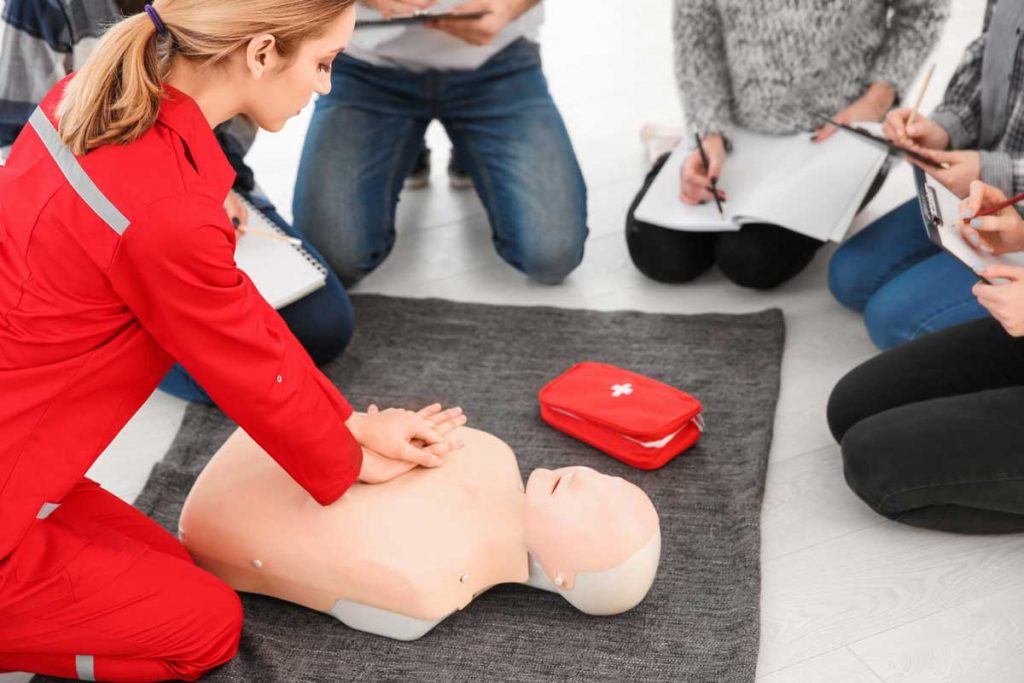
You do not require medical college degree expertise. What trainers wish to see is proper use fundamental techniques and sound judgment: you acknowledge a lethal problem, you act without delay with the right method, and you call for help appropriately.
How to research effectively for fast first aid and CPR assessments
Fast first aid courses press time, not content, so your study strategy should be lean and concentrated. Lots of individuals over-read, under-practice, and appear emotionally overloaded.
A better pattern looks like this.
First, make use of the course's official student guide, workbook, or on-line module as your main referral. Overlook the temptation to stray with random net online forums that might use different guidelines or obsolete info. If your provider has a certain fap first aid handbook or neighborhood standard set, stick to that.
Second, break content into pieces based upon most likely assessments. For example, treat CPR for adults, CPR for infants, choking, bleeding, and recuperation position as separate micro-skills. For every, recognize three points: when to utilize it, just how to do it, and typical mistakes.
Third, utilize energetic recall. Do not simply check out CPR actions. Shut your eyes and speak on your own through what you would do if someone broke down in front of you at the supermarket. Out loud, ideally. When you obtain stuck, open up guide, proper yourself, after that duplicate the scenario.
Fourth, visualise the setting. If you recognize you will be working with manikins, think of kneeling at their side, where your hands go, where your body weight is. If your course makes use of AED instructor tools, photo turning one on and following the triggers. This sort of wedding rehearsal sounds straightforward, but it cuts down reluctance when the evaluation starts.
Finally, if you fight with created tests, allow your fitness instructor understand early. Several service providers can provide affordable adjustments such as spoken questioning, longer time, or different formats, as long as the stability of the first aid and cpr course is preserved. They can not assist you if they only learn when you hand in an empty test paper.
Managing nerves and performing under pressure
The most qualified trainees are not constantly the calmest. I have seen experienced childcare staff, that deal with scraped knees daily, freeze during the official express child care first aid course assessment because they feel seen and judged. At the exact same time, full beginners commonly do surprisingly well, just because they listen, comply with guidelines, and do not overthink.
A few approaches aid nearly everyone.
Anchor yourself in the series, not the outcome. Instead of assuming, "I have to pass this first aid certificate assessment or my task is at threat", believe, "Today my task is just to check for danger. Currently action. Currently respiratory tract." Focus on the next right activity, not the whole scenario.
Talk your means via. Instructors assessing fast first aid courses are paying attention as long as they are seeing. If you state, "I am checking for risk to myself and others. I am placing on handwear covers if readily available," that reveals structured thinking, also if your hands are a little clumsy at first.
Use the manikin as method, not performance. During ability terminals ahead of analysis, treat every rep as if it is the first aid and cpr courses Cannon Hill actual point. By the time the official examination starts, your body will certainly know what to do, also if your ideas feel scattered.
Breathe. It appears evident, yet lots of people hold their breath while concentrating. Short, superficial breathing magnifies anxiety and makes you tire quicker during CPR. A few sluggish exhalations before you begin can resolve your hands.
Remember that reassessment is regular. Also if you do miss an action, the majority of trainers in fast first aid courses will offer a 2nd chance within the day. They want you to be competent, not embarrassed. Knowing that the very first effort is not your only chance commonly takes some pressure off.
Common mistakes that sabotage a new pass
With numerous classes behind me, I can nearly predict that will certainly struggle within the initial hour. The patterns are that constant. If you stay clear of these catches, you currently boost your odds.
Arriving late or flustered. You miss out on the security rundown, really feel hurried, and spend the remainder of the session on the back foot.
Skipping pre-course work. In fast first aid and cpr courses, fitness instructors assume you currently recognize fundamental ideas. If you get here blank, the session ends up being restorative for you and irritating for everyone else.
Arguing standards instead of learning them. There is constantly somebody that insists, "However on that television show, they did CPR in a different way," or, "My uncle, that is a registered nurse, says you ought to do it in this manner." Standards alter, and courses are examined versus existing standards. Even if you differ, you need to execute the taught approach to pass.
Underestimating the physical side. Fast cpr, specifically on adult manikins, is actual work. Individuals with bad top body toughness or injuries occasionally hit the wall surface throughout the assessment due to the fact that they never ever exercised a full 2 mins of compressions in one burst. If this could be you, examination yourself carefully in your home on a firm cushion or pillow to gauge your stamina.
Switching off after lunch. The last hour of a fast first aid course often includes important consolidated scenarios and analyses. I on a regular basis see attention drift as individuals emotionally head home. Do not allow your focus slip right prior to the goal.
The factor is not to frighten you yet to highlight that the majority of barriers to passing are behavioral, not intellectual. Program up ready, interested, and participating, and you will currently be in the leading half of the room.
Making your new abilities stick after you pass
Earning the certificate is one thing. Being able to act months later on when a genuine emergency situation happens is an additional degree. Fast certification formats are effective, however understanding can discolor quickly if you never ever utilize it.
To keep your first aid and CPR abilities fresh:
Review your notes or learner overview within a week and again at the one month mark. Short, spaced refresher courses assist protect versus failing to remember.
Teach a buddy or family member one easy ability, such as exactly how to identify cardiac arrest and begin CPR. Teaching is just one of the most powerful ways to reinforce your own understanding.
If your supplier offers optional short practice, specifically for express cpr training, make use of them. Also 15 mins on a manikin every couple of months can keep your strategy sharp.
Schedule your next fast cpr correspondence course as soon as your certificate shows up, even if it is a year or more away. Having the renewal day in your schedule quits it from slipping up on you.
Stay interested when you experience actual cases, even minor ones. If a kid in your care has a mild asthma flare, for instance, mentally walk through exactly how you would escalate if it came to be serious. That psychological rehearsal maintains the choice paths clear.
Fast first aid courses provide you a powerful toolkit in a portable package. Passing on the first try is much less concerning stuffing and a lot more regarding straightening exactly how you prepare with exactly how you will be examined. Recognize the structure, exercise the core abilities, respect the physical work of CPR, and treat the day as an opportunity to become reliably valuable to other people when they need it most.

Do that, and leaving with your first aid certificate really feels much less like making it through an examination and more like gaining a duty you are ready to carry.